

































FirstBank Raises Naira Card International Spending Limit to $50,000 Quarterly ……Move gives customers more freedom to travel, shop, pay for global services
FirstBank Raises Naira Card International Spending Limit to $50,000 Quarterly ……Move gives customers more freedom to travel, shop, pay for global services

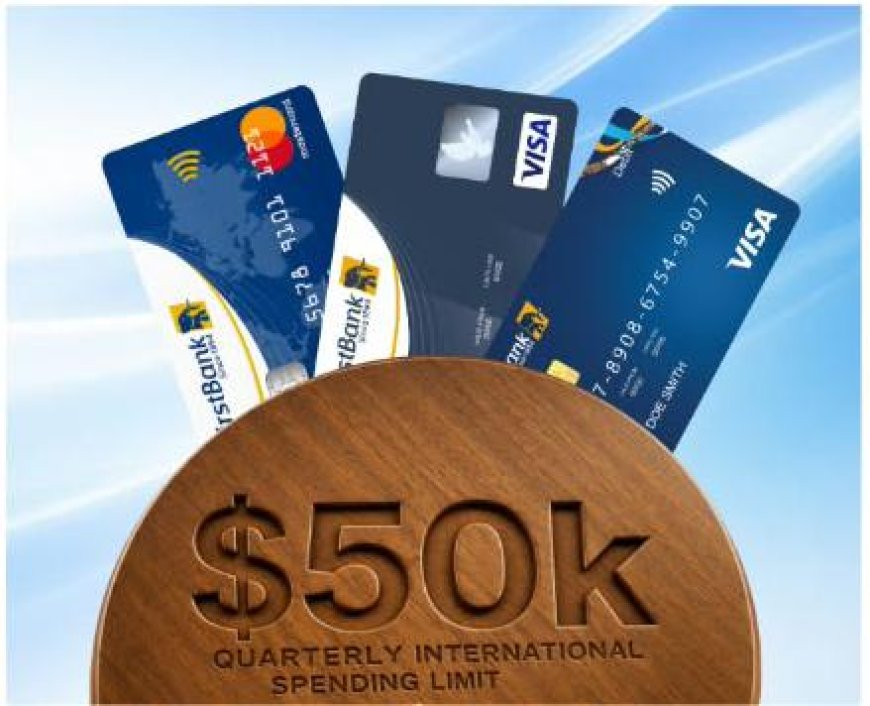
FirstBank of Nigeria has announced a major expansion of the international spending capacity of its Naira cards, raising the quarterly international spending limit to as much as $50,000 for eligible customers.
The development, which is expected to provide greater flexibility for Nigerians who routinely make legitimate foreign-currency payments, covers FirstBank Naira Mastercard, Platinum Mastercard, Naira Visa Debit Card and Naira Credit Card.
The bank announced the new limit in a communication to its customers, describing the initiative as an effort to provide them with “more freedom to spend globally.”
According to the bank, customers can now use their FirstBank Naira cards for international payments, travel-related expenses, online shopping, subscriptions and other legitimate transactions within the applicable card limits and regulatory requirements.
The new arrangement represents a significant expansion of the purchasing power available to customers using Naira-denominated cards for transactions outside Nigeria and comes at a time when international digital commerce, travel, education, professional services and online subscriptions have become increasingly important to Nigerians.
With Nigerians interacting with the global economy in more ways than ever before, access to convenient and reliable international payment channels has become an important component of personal finance and business operations.
For frequent travellers, students paying for international services, professionals subscribing to global platforms, online shoppers and businesses purchasing goods or services from overseas suppliers, the ability to make payments conveniently with a locally issued card can reduce some of the challenges associated with international transactions.
The FirstBank announcement therefore goes beyond an increase in a card limit. It signals a broader attempt to make its cardholders more financially mobile in an increasingly interconnected global marketplace.
A changing global spending landscape
The nature of consumer spending has changed considerably in recent years.
A Nigerian consumer no longer needs to travel outside the country before participating in international commerce. From software subscriptions and digital advertising to online courses, hotel bookings, airline tickets, international examinations and e-commerce purchases, a growing range of goods and services can be purchased from a mobile phone or computer.
This has increased demand for cards capable of processing international transactions efficiently.
For businesses, particularly small and medium-sized enterprises, international card payments can also be relevant to purchasing software, digital tools, advertising services, professional subscriptions and other inputs required to operate in a globalised economy.
For individuals, international payments can include hotel reservations, airline bookings, streaming services, educational platforms, cloud storage, software subscriptions and online purchases.
FirstBank's decision to increase its quarterly international spending limit to $50,000 could therefore appeal to a broad customer base whose financial activities increasingly cross national borders.
The bank said the increased limit applies to its Naira Mastercard, Platinum Mastercard, Naira Visa Debit Card and Naira Credit Card, effectively widening the range of customers who can benefit from the enhanced international spending capacity.
More flexibility for travellers
For Nigerians travelling abroad, payment flexibility is one of the major considerations when planning a trip.
International travellers need to pay for accommodation, transportation, meals, shopping and other services. While cash remains useful, card payments have become an important component of international travel because they offer convenience and can reduce the need to carry large amounts of physical cash.
The new FirstBank limit could provide greater room for customers who have substantial legitimate international expenses during a quarter.
Business travellers may particularly benefit where expenses involve accommodation, airline tickets, conference registration, transportation and other travel-related services.
For families travelling abroad, the ability to make international payments from a Nigerian bank account through a Naira card could also provide additional convenience.
The initiative could consequently strengthen the role of bank cards as an everyday financial tool for Nigerians travelling for business, tourism, education, healthcare, conferences and other legitimate purposes.
Online shopping gets another boost
The growth of e-commerce has fundamentally changed how Nigerians purchase goods.
International shopping platforms have made products from different parts of the world accessible to consumers in Nigeria. However, the ability to complete transactions depends heavily on the availability and reliability of international payment channels.
A higher international spending limit gives customers more room to complete legitimate transactions without repeatedly encountering low card ceilings.
For consumers who purchase high-value products or make several international purchases during a quarter, the increased limit could offer greater convenience.
It also potentially benefits customers who combine several categories of international spending, such as travel, online shopping, software subscriptions and other digital services.
The bank's message is straightforward: customers should be able to use their FirstBank cards to participate more freely in global commerce.
Subscriptions and digital services
Another area where international card payments have become increasingly important is the digital economy.
Nigerians subscribe to a wide range of foreign-based digital services, including professional software, educational platforms, cloud services, entertainment platforms, productivity tools and other online products.
For entrepreneurs, freelancers and professionals, some of these subscriptions are not merely conveniences but essential business tools.
A graphic designer may require international design software. A digital marketer may need advertising and analytics platforms. A software developer may pay for cloud computing or development tools. A journalist or researcher may subscribe to international databases and information services.
For these categories of users, the ability to make international payments reliably can have a direct impact on productivity.
The increased FirstBank limit could therefore be viewed against the background of Nigeria's expanding participation in the digital economy.
Implications for businesses
The announcement also has potential significance for Nigerian businesses.
As local companies increasingly interact with suppliers, service providers and customers outside Nigeria, international payments have become part of normal business activity.
A company may need to pay for international software, digital advertising, professional services, travel arrangements or other legitimate business expenses.
For businesses with authorised employees or executives using corporate or personal cards for approved expenses, increased international card capacity can offer another payment option.
Small businesses may particularly value the convenience of card payments where international suppliers or service providers accept Mastercard or Visa.
The development could also contribute to a broader shift in consumer behaviour from cash-based transactions towards electronic payments.
Convenience meets financial control
While greater spending power can provide convenience, responsible use remains important.
An increased international spending limit does not mean customers should spend beyond their financial capacity. Rather, it provides a larger ceiling within which legitimate transactions can be conducted.
Customers still need to exercise financial discipline and understand the applicable charges, exchange rates, card terms and conditions, transaction requirements and regulatory provisions governing international payments.
The development also highlights the growing importance of financial literacy.
As Nigerian consumers become more active participants in global commerce, understanding the cost of foreign transactions, currency conversion and personal spending limits becomes increasingly important.
For businesses, proper documentation and internal controls around international expenses remain equally essential.
A changing banking environment
The FirstBank announcement comes against the backdrop of rapid changes in Nigeria's banking and payments environment.
The modern Nigerian bank customer increasingly expects more than a place to keep money. Customers want to transfer funds instantly, pay bills, shop online, subscribe to digital services, travel with their cards and conduct transactions beyond Nigeria.
Banks are therefore under pressure to develop payment solutions that reflect the changing lifestyles and commercial needs of their customers.
The expansion of international card spending capacity is part of that wider evolution.
For FirstBank, one of Nigeria's oldest financial institutions, the move also reinforces the importance of its card business in serving customers whose financial activities increasingly extend beyond the domestic market.
The bank's communication places emphasis on freedom, flexibility and spending power, reflecting the expectations of modern consumers who want their financial tools to work wherever legitimate commerce takes them.
What the $50,000 limit means
At its core, the new limit gives eligible FirstBank Naira cardholders a substantially larger quarterly international spending window.
A customer who travels frequently, runs a business with international expenses or regularly pays for overseas digital services can potentially consolidate more of those payments through a single card.
The significance of the $50,000 figure is therefore not necessarily that every customer will spend that amount.
Rather, it establishes a higher spending ceiling for customers whose legitimate needs require greater international payment capacity.
For the average customer, the limit may be far above normal spending requirements. For high-frequency travellers, business owners and customers with substantial overseas expenses, however, the additional capacity could be particularly valuable.
The bank's decision to apply the increased limit across several card categories also means that the initiative is not restricted to one specialised product.
Positioning customers for a global economy
Nigeria's economy is increasingly connected to global markets.
From technology and entertainment to education, tourism, professional services and e-commerce, Nigerians interact with international businesses every day.
This creates a corresponding demand for financial infrastructure capable of supporting such interactions.
The ability to make international payments conveniently can be an important enabler of this participation.
For a young Nigerian professional taking an international course, an entrepreneur paying for global software, a family booking an overseas holiday or a company purchasing an international service, the payment process is an important part of the transaction itself.
Any improvement in the payment experience can therefore have an impact beyond the banking sector.
It can influence how easily individuals and businesses access international opportunities.
The road ahead
The latest development also underscores the continuing evolution of Nigeria's card and electronic-payment ecosystem.
As digital commerce expands, customers are likely to demand payment products that are increasingly flexible, secure and capable of supporting transactions across borders.
Banks, fintech companies and payment providers will consequently continue to compete around convenience, transaction limits, reliability, security and customer experience.
For FirstBank customers, the immediate attraction is clear: a higher international spending ceiling on eligible Naira cards.
But the broader significance is the changing relationship between Nigerian consumers and the global economy.
The distinction between domestic and international commerce is becoming less visible in everyday life. A business meeting may be booked online, a hotel paid for from Lagos, software purchased from the United States, a course delivered from Europe and goods ordered from Asia, all within a single day.
Payment infrastructure has to keep pace with that reality.
By raising the quarterly international spending limit on its Naira cards to $50,000, FirstBank is positioning its cardholders to participate more easily in that global marketplace.
For customers, the message from the bank is essentially one of greater flexibility: travel, shop and spend globally, while using their FirstBank cards for legitimate international transactions.
The real test, however, will be how customers utilise the expanded capacity and how effectively the banking system continues to combine greater convenience with security, transparency and responsible financial management.
For a country whose citizens and businesses are increasingly connected to the world through technology, travel and commerce, access to dependable international payment channels is no longer simply a luxury.
It is becoming an essential part of modern financial life.
What's Your Reaction?

















 The Chairman and Chief Executive Officer of Adron Homes and Properties Limited, Aare Adetola Emmanuelking, has congratulated the Government and people of Oyo State as the state marks its 50th anniversary, describing the occasion as a celebration of resilience, cultural pride, and sustained progress.