






























Democracy Day: How NASENI is Driving Nigeria’s Industrial Revolution Through Research Commercialisation
Democracy Day: How NASENI is Driving Nigeria’s Industrial Revolution Through Research Commercialisation


As Nigeria marks another Democracy Day, the National Agency for Science and Engineering Infrastructure (NASENI) has highlighted its growing role in transforming research innovations into commercially viable products, positioning itself as a critical driver of the country's industrialisation agenda under the current administration.
Across Asia, industrial powerhouses such as Japan, China, Singapore, and Vietnam have built strong economies by converting research, innovation, and technology into market-ready products. These nations have successfully linked research institutions with manufacturing industries, creating jobs, wealth, and sustainable economic growth.
Nigeria has long struggled with a disconnect between research outputs and commercial production. For decades, innovations developed in laboratories and universities rarely progressed to large-scale manufacturing or reached consumers. NASENI is now changing that narrative by establishing a seamless pathway from research and development (R&D) to industrial production and market deployment.
Bridging the Gap Between Innovation and Industry
Unlike conventional research institutions, NASENI's mandate extends beyond innovation to technology adaptation, manufacturing, commercialisation, and industrial partnerships.
Through its network of development institutes and advanced manufacturing centres nationwide, the Agency has adopted a strategy of reverse engineering and technology adaptation, enabling Nigerian engineers to redesign imported technologies to suit local conditions and manufacturing capabilities.
This approach has resulted in the development of numerous indigenous technologies across key sectors, including agriculture, renewable energy, transportation, information technology, and power infrastructure.
According to the Agency, the objective is to reduce Nigeria's dependence on imported products, conserve foreign exchange, create employment opportunities, and provide affordable technologies tailored to local needs.
Building a Complete R&D-to-Market Value Chain
NASENI has developed a structured five-stage commercialisation framework designed to accelerate industrial growth and encourage private-sector participation.
The process begins with identifying products heavily imported into Nigeria and adapting their designs using locally available materials and expertise. Engineers then develop and test prototypes to ensure durability, efficiency, and compliance with national standards.
Successful prototypes proceed to pilot production, where small-scale manufacturing validates quality, scalability, and production costs before full commercial deployment.
The next stage involves technology transfer and licensing arrangements, allowing investors and manufacturers to adopt NASENI-developed technologies without incurring the high costs and risks associated with establishing independent research and development departments.
The final stage focuses on market deployment through partnerships with distributors, cooperatives, state governments, and private-sector operators, backed by technical support and after-sales services.
Indigenous Technologies Transforming Key Sectors
Over the last three years, NASENI has expanded its portfolio of indigenous technologies designed to support Nigeria's economic diversification efforts.
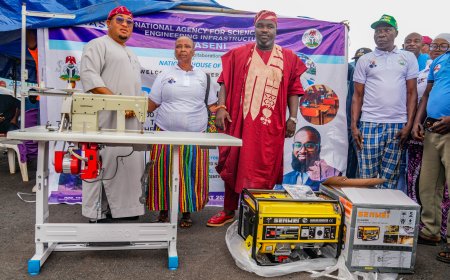
These innovations include multi-grain threshers, rice milling and destoning machines, solar-powered irrigation pumps, oil extraction systems, solar water dispensers, home solar energy solutions, solar street lighting systems, lithium batteries, electric and hybrid vehicles, electric tricycles, laptops, tablets, and several other locally engineered products.
Many of these technologies have already advanced to the commercialisation and licensing stages, creating opportunities for manufacturers, distributors, and investors across the country.
For instance, agricultural equipment companies can adopt NASENI-developed threshers and processing equipment for local assembly and distribution, while renewable energy firms can integrate locally designed solar technologies into their operations at reduced costs.
Unlocking Opportunities for Industry
NASENI says its commercialisation model offers significant advantages to industry players.
By licensing existing technologies, manufacturers can reduce the time required to bring products to market, avoiding years of costly research and development. The adaptation of products for local materials and labour also lowers production costs and reduces reliance on imports.
Furthermore, businesses gain access to tested prototypes, technical documentation, and ongoing support, significantly reducing investment risks.
The Agency noted that its technologies are designed to align with Nigeria's local content requirements, providing additional opportunities for participation in government procurement and public-sector projects.
Strengthening Manufacturing Through Shared Infrastructure
One of NASENI's major contributions to industrial development is the establishment of advanced manufacturing facilities equipped with Computer Numerical Control (CNC) machines, 3D printing technologies, metrology laboratories, and testing centres.
These facilities are accessible to manufacturers, particularly small and medium-sized enterprises (SMEs), on a fee-for-service basis, enabling them to access sophisticated production infrastructure without making substantial capital investments.
The shared infrastructure model is expected to enhance productivity, improve product quality, and strengthen local manufacturing capabilities.
Driving Industrialisation Through Partnerships
To maximise impact, NASENI continues to deepen collaborations with manufacturers, investors, distributors, and state governments.
The Agency's partnership model includes technology assessments, licensing agreements, technical training, production support, and continuous product improvement through market feedback mechanisms.
These collaborations are designed to accelerate industrial growth while ensuring that locally developed technologies meet evolving market demands.
A Vision for Nigeria's Industrial Future
As Nigeria pursues economic diversification and industrial expansion, NASENI believes indigenous technology development and commercialisation will remain central to achieving sustainable growth.
The Agency has therefore called on manufacturers, investors, development partners, and state governments to leverage its technologies and infrastructure to expand local production capacity.
With tested designs, modern manufacturing facilities, and a growing portfolio of commercial-ready technologies, NASENI says the foundation has been laid for a new era of industrial development driven by Nigerian innovation.
As the nation celebrates Democracy Day, the Agency's achievements over the past three years underscore the increasing role of science, technology, and innovation in building a resilient economy and advancing the vision of a globally competitive "Made-in-Nigeria" industrial sector.
What's Your Reaction?

















 The Chairman and Chief Executive Officer of Adron Homes and Properties Limited, Aare Adetola Emmanuelking, has congratulated the Government and people of Oyo State as the state marks its 50th anniversary, describing the occasion as a celebration of resilience, cultural pride, and sustained progress.