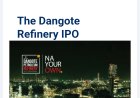




























Dangote Refinery IPO: N5,250 Opens Door to Nigerians as 4.1bn Shares Go on Offer ….Investors eye Africa’s largest refinery as proposed share sale targets expansion, deeper capital-market participation
Dangote Refinery IPO: N5,250 Opens Door to Nigerians as 4.1bn Shares Go on Offer ….Investors eye Africa’s largest refinery as proposed share sale targets expansion, deeper capital-market participation

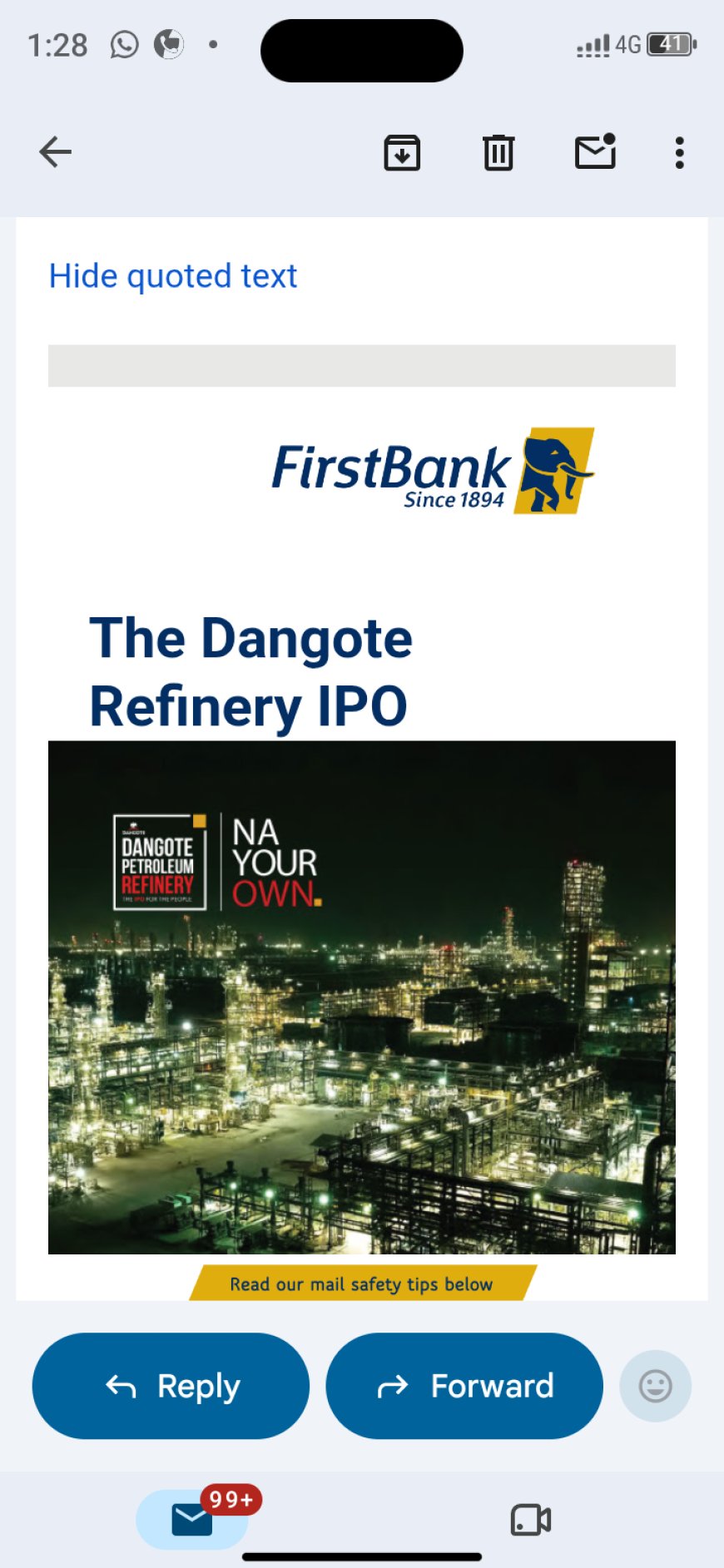
A new chapter may be opening in Nigeria’s capital market as the proposed Initial Public Offering (IPO) of Dangote Petroleum Refinery & Petrochemicals FZE prepares to offer millions of Nigerians an opportunity to acquire an equity stake in one of the country’s most ambitious industrial projects.
Under the offer details circulated to prospective investors, about 4.1 billion ordinary shares are expected to be offered at N525 per share, putting the minimum entry point at N5,250 for 10 shares, with subsequent subscriptions in multiples of 10 shares.
The proposed offer, scheduled to open on September 14, 2026 and close on October 13, 2026, is expected to be listed on the Main Board of the Nigerian Exchange Limited, subject to the applicable regulatory and listing processes.
For many Nigerians accustomed to seeing large corporate investments as opportunities reserved for institutional investors and wealthy individuals, the proposed Dangote Refinery share sale represents a potentially significant shift.
With a minimum subscription of N5,250, retail investors would have a relatively low-cost entry point into the equity offering, although prospective investors are expected to study the approved prospectus carefully before committing their funds.
The refinery, located in the Lekki area of Lagos State, has emerged as one of the most significant private-sector investments in Nigeria’s energy industry.
Its current refining capacity is stated at 700,000 barrels per day, while its operations cover refining and petrochemicals, with production targeted at meeting international quality standards, including Euro V-compliant petroleum products.
The proposed IPO therefore goes beyond an ordinary share offering. At stake is the question of how Nigerians can participate in the ownership of an industrial asset that has become increasingly important to the country’s petroleum supply chain.
According to the offer information, proceeds from the share sale are intended primarily for refinery expansion capital expenditure.
The proposed expansion is expected to take the facility towards approximately four million barrels per day by 2029, a scale that would substantially alter the refinery’s position within Nigeria’s petroleum industry if achieved.
For the capital market, the proposed transaction could also become a major test of investor appetite for large-scale Nigerian industrial assets.
The offer comes at a time when the country is seeking greater domestic participation in economic growth, deeper investment opportunities and stronger mobilisation of local savings into productive assets.
A successful IPO could consequently have implications beyond the Dangote Group, particularly if it demonstrates that large Nigerian infrastructure and industrial projects can attract substantial participation from ordinary citizens through the capital market.
Financial analysts have consistently stressed that an IPO should not be viewed simply as an opportunity to buy shares in a famous company.
Investors are effectively purchasing an interest in a business and therefore need to understand the company’s financial position, business model, risks, prospects, corporate governance structure and intended use of the funds being raised.
The proposed Dangote Refinery offer similarly places responsibility on prospective investors to examine the prospectus and make decisions based on their individual financial circumstances and risk tolerance.
For retail investors, the attraction is obvious: a relatively modest amount of money could provide access to an equity investment in a major Nigerian industrial enterprise.
The offer information also indicates that eligible retail investors may receive bonus shares at no additional cost, subject to the conditions contained in the prospectus.
However, bonus shares should not be confused with guaranteed returns. Like other equity investments, the value of shares after listing can rise or fall depending on the company's performance, market conditions, investor sentiment and wider economic developments.
The proposed transaction is also significant because of what the refinery represents in Nigeria’s long-running struggle with petroleum-product supply and dependence on imported refined products.
For decades, Nigeria produced crude oil on a large scale while relying heavily on imports of refined petroleum products. The emergence of a major private refinery capable of processing substantial volumes of crude has changed the dynamics of that conversation.
The Dangote refinery has increasingly become a focal point in debates around domestic refining, fuel availability, foreign exchange pressure, energy security and industrial development.
Its integrated refining and petrochemical operations could potentially create value across several parts of the petroleum value chain, while reducing some of the logistics associated with importing finished petroleum products.
The proposed expansion, if successfully funded and executed, would further increase the facility’s potential significance.
But the size of the ambition also means investors will be watching execution closely.
Questions around future capital requirements, operating costs, crude supply, product demand, international oil prices, foreign exchange movements, regulation and competition will remain relevant to the company's long-term performance.
For Nigeria’s capital market, meanwhile, the proposed listing could broaden the range of major domestic companies available to investors.
It could also provide an opportunity for Nigerians who have traditionally participated in the economy mainly as consumers to become shareholders in a major industrial enterprise.
The role of financial institutions will therefore be important in helping investors understand the process.
FirstBank, according to its investor communication, is acting solely as a Receiving Bank for the offer. The bank says applications will be accessible through channels including FirstMobile, FirstOnline, PayByLink, LIT App, FirstDirect for corporate customers, its Agency Banking outlets and branches nationwide when the offer opens.
The minimum subscription of 10 shares means an investor could begin with N5,250 at the stated offer price, while larger investors can subscribe in multiples of 10 shares.
Payment, according to the offer details, is to be made in full on application.
The proposed offer is also being presented as Shariah compliant under applicable screening criteria, potentially widening its appeal among investors seeking investments that meet Islamic finance screening requirements.
For the ordinary Nigerian, however, the central question is likely to be straightforward: does owning a small stake in the refinery make financial sense?
The answer cannot be determined simply by the reputation of the Dangote name or the prominence of the refinery.
An IPO is an investment, not a savings account, and there is no automatic guarantee that an investor will make money after purchasing shares.
The eventual market price can trade above or below the offer price after listing. Investors may also need to hold their shares for an extended period to realise their investment objectives.
This makes the prospectus particularly important.
The prospectus is expected to provide the detailed information required for informed investment decisions, including the company's financial information, risks, business plans, corporate structure and terms of the offer.
For the Nigerian Exchange, the proposed listing could become another landmark transaction capable of attracting renewed attention to equities and encouraging greater retail participation.
It could also test whether Nigerians are prepared to move beyond traditional investment choices and put a portion of their savings into businesses that are central to the country's industrial transformation.
The refinery itself has already become more than an energy project. It is increasingly regarded as a symbol of Nigeria's attempt to develop large-scale private industrial capacity.
Its success or otherwise will have consequences for petroleum supply, manufacturing, employment, logistics, foreign exchange demand and Nigeria's broader industrial ambitions.
Consequently, the proposed IPO places the refinery and the Nigerian capital market at an interesting intersection.
On one side is a major industrial company seeking capital to support expansion. On the other are institutional and retail investors looking for opportunities to preserve and grow wealth in an economy facing inflation, currency volatility and changing investment conditions.
The proposed offer provides a bridge between the two.
Whether that bridge becomes one of Nigeria's most successful capital-market transactions will ultimately depend on investor confidence, corporate performance, market conditions and the company's ability to deliver on its expansion plans.
For now, the countdown is on.
With the offer scheduled to open on September 14, prospective investors have a limited window to familiarise themselves with the terms, study the prospectus and decide whether the opportunity fits their investment objectives.
The N5,250 minimum entry point may make the proposed offer accessible to a broad segment of Nigerians, but accessibility should not be mistaken for suitability.
As the refinery seeks additional capital for expansion and the capital market prepares for another potentially landmark transaction, the coming weeks will reveal just how strong Nigerians' appetite is for owning a piece of one of the country's most closely watched industrial ventures.
For investors, the message is simple: read the prospectus, understand the risks and make an informed decision before subscribing.
What's Your Reaction?














 The Chairman and Chief Executive Officer of Adron Homes and Properties Limited, Aare Adetola Emmanuelking, has congratulated the Government and people of Oyo State as the state marks its 50th anniversary, describing the occasion as a celebration of resilience, cultural pride, and sustained progress.